

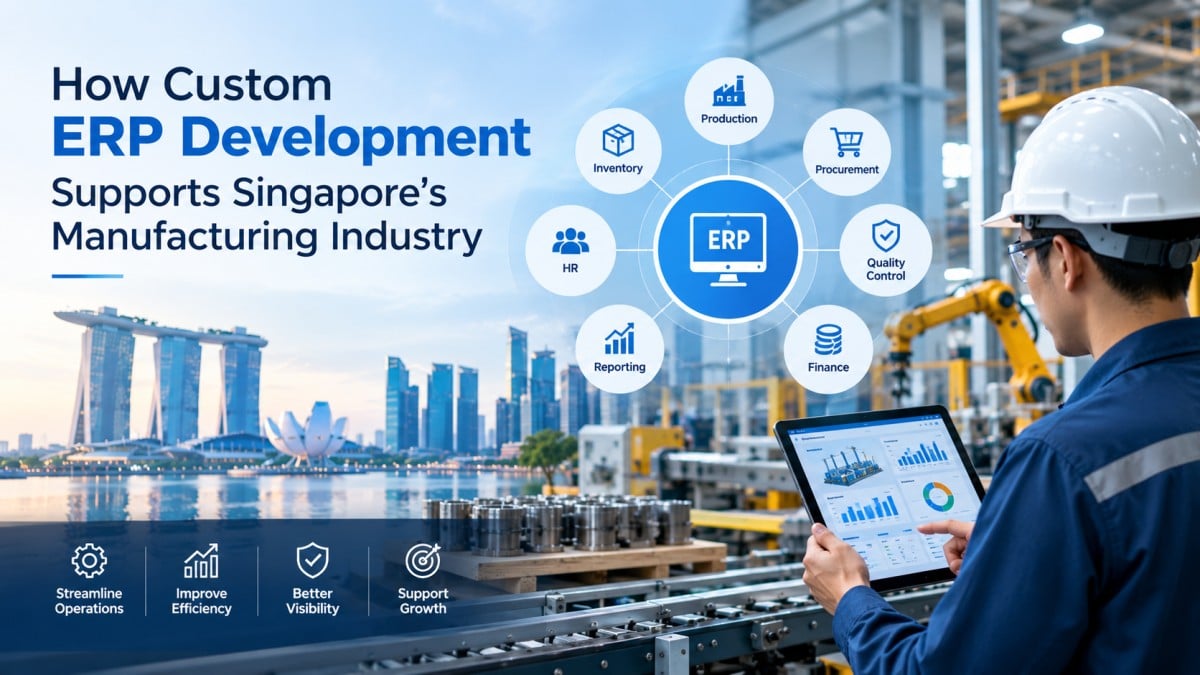
Manufacturing companies in Singapore must balance production targets, material availability, quality standards, workforce planning, and customer expectations. As operations become more complex, managing these activities through separate applications and spreadsheets can create delays, increase costs, and make accurate reporting difficult.
Custom ERP Development offers manufacturers a way to connect essential business processes within a centralized system. By aligning software with actual production workflows, businesses can improve operational visibility, coordinate resources, and respond more effectively to changing demand.
For manufacturers exploring ERP development in Singapore, the right solution can support better production planning, inventory control, quality management, and long-term business growth.
Why Does Singapore’s Manufacturing Industry Need ERP Development?
Manufacturing involves multiple connected activities, from purchasing raw materials to producing, inspecting, storing, and delivering finished goods. A problem in one area can affect the entire production cycle.
For example, a shortage of essential components may delay production, while inaccurate inventory records can lead to unnecessary purchasing. Limited visibility into machine performance may also make production planning less reliable.
ERP development helps manufacturers connect these activities so that teams can work with more consistent and accessible information.
A suitable manufacturing ERP system can help businesses:
- Monitor production schedules and work orders.
- Track raw materials and finished goods.
- Coordinate procurement and supplier deliveries.
- Record quality inspections and production issues.
- Compare production costs with planned budgets.
- Generate reports for operational decision-making.
These capabilities help manufacturers establish more organized workflows and reduce dependence on disconnected systems.
Key Benefits of Custom ERP Development for Manufacturers
1. Better Production Planning and Scheduling
Manufacturers need to coordinate machines, labor, materials, and delivery deadlines. Poor scheduling can result in idle equipment, missed orders, and production bottlenecks.
Custom ERP software can connect production orders with material availability, capacity planning, and work center schedules. Depending on the system’s capabilities, managers can review production progress, identify delays, and adjust schedules when priorities change.
This helps businesses align manufacturing activities with customer demand and available resources.
2. Improved Inventory and Supply Chain Management
Maintaining the right quantity of materials is essential for uninterrupted production. Excess stock ties up working capital, while insufficient inventory can stop production lines.
ERP systems can track stock movements, warehouse quantities, purchase orders, and material consumption. Features such as barcode scanning, batch tracking, and serial number management can provide additional visibility where required.
For Singapore manufacturers working with regional suppliers and international customers, connected inventory and procurement workflows can also improve coordination across purchasing, warehousing, and production teams.
3. Stronger Quality Control and Traceability
Product quality is important for manufacturers serving industries with strict customer specifications and documentation requirements.
A manufacturing ERP solution can record inspection results, material batches, production stages, and non-conformance reports. Depending on the implementation, it may also connect quality checks with work orders and corrective actions.
These records help businesses investigate production issues, identify affected batches, and maintain more consistent quality documentation.
4. More Accurate Manufacturing Cost Analysis
Manufacturing costs include raw materials, labor, machine usage, utilities, and other operational expenses. When these costs are recorded separately, understanding product profitability becomes more difficult.
Custom ERP development can connect production transactions with inventory valuation and accounting records. Businesses can use this information to compare estimated and actual production costs, evaluate material consumption, and identify areas where expenses are increasing.
Better cost visibility supports more informed pricing, budgeting, and operational planning.
5. Integration With Existing Business Applications
Manufacturers may already use accounting software, CAD applications, warehouse systems, customer management tools, or production monitoring equipment.
A well-designed ERP solution can integrate compatible applications through APIs, connectors, or other suitable interfaces. Where technically feasible, production data can be connected with inventory and business records to reduce duplicate entry.
Integration requirements should be assessed carefully to ensure reliable data exchange, suitable access controls, and maintainable system architecture.
Why Choose ERP Development Services for Manufacturing?
Standard ERP software can support many common manufacturing activities. However, businesses with specialized production methods, complex bills of materials, or unique approval procedures may require additional customization.
Professional ERP Development services can help manufacturers evaluate their requirements and determine which features should be configured, integrated, or developed specifically for their operations.
Important considerations include:
- Custom production workflows and work order management
- Bill of materials (BOM) and material requirement planning
- Multi-warehouse inventory tracking
- Equipment maintenance and downtime records
- Quality assurance and product traceability
- Management dashboards and production reports
The best approach is to retain standard functionality wherever practical and customize only where it provides measurable business value.
How to Select the Right ERP Development Partner in Singapore
Choosing a suitable ERP provider requires more than comparing software features or initial quotations.
Manufacturers should evaluate the provider’s technical capabilities, understanding of production workflows, integration experience, and implementation methodology.
Before proceeding, clarify the following:
- Business requirements: Identify production challenges and essential system functions.
- Project scope: Define modules, integrations, deliverables, and implementation milestones.
- Data migration: Establish how existing inventory, supplier, and production records will be transferred and validated.
- Testing and training: Ensure the system is tested against real workflows and employees receive appropriate training.
- Security and maintenance: Review access permissions, backups, upgrades, and ongoing technical support.
Manufacturers evaluating ERP development in Singapore should also consider applicable industry standards, contractual requirements, and relevant regulatory obligations.
How SerpentCS Can Fit Into Your ERP Plans
Manufacturers exploring ERP customization and business process automation can consider SerpentCS as a potential development partner.
Discuss your production processes, inventory requirements, reporting needs, and existing applications to determine whether the proposed solution matches your operations. Request details about relevant project experience, implementation deliverables, integration capabilities, and post-launch support before making a decision.
A clear assessment of business requirements helps establish realistic project goals and reduces the risk of investing in unnecessary features.
Conclusion
Custom ERP development can help Singapore’s manufacturing companies connect production planning, inventory management, procurement, quality control, and financial reporting within a more coordinated system.
By investing in suitable ERP development services, manufacturers can improve resource utilization, strengthen operational visibility, and build workflows that support future expansion.