




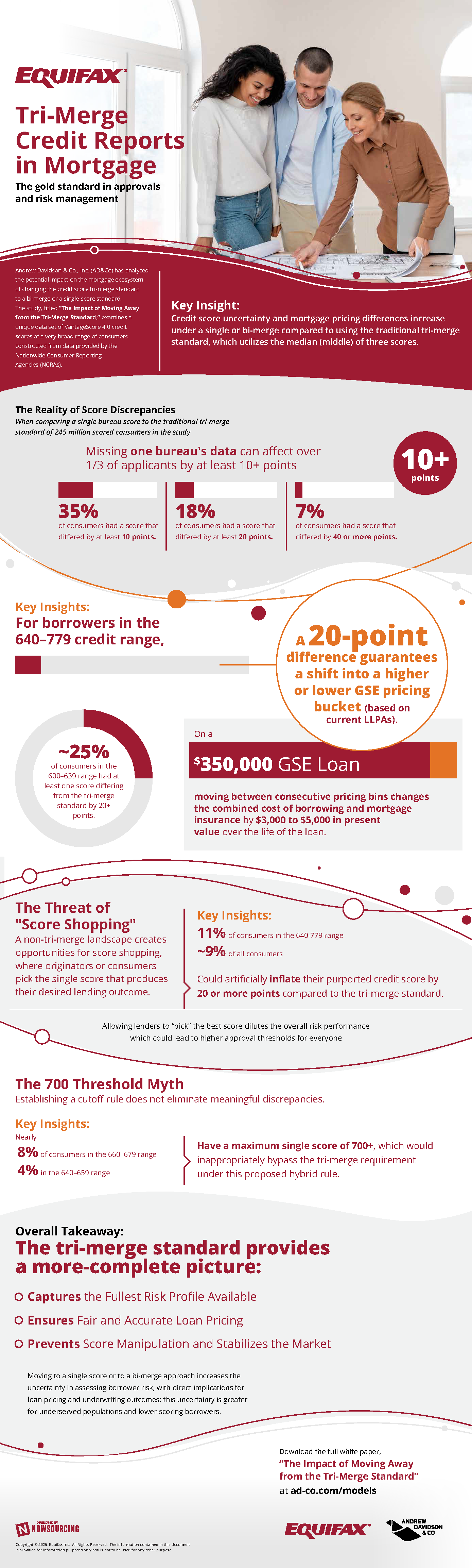
When it comes to screening applicants for loans, it’s incredibly important to know the prospective borrower’s information. Traditionally, this has meant ordering as much information as possible, even at the risk of getting redundant information. For this reason, the tri-merge credit report has reigned as the standard for mortgage lenders. Essentially, tri-merge credit reports are the culmination of credit reports from the 3 major credit bureaus: TransUnion, Equifax, and Experian. After ordering these reports, analysts will gather all the information and view the prospective borrower comprehensively. If determined eligible, the lender will take all 3 credit scores that the bureaus calculated and use the median score for loan pricing.
While ordering a credit report on the same applicant 3 times can be redundant, it is essential to ensure accuracy throughout the mortgage process. By omitting even just 1 bureau, it is estimated that around 1 in 3 applicants saw a credit score difference of at least 10 points, and around 1 in 5 applicants would see a difference of 20 points or more. Furthermore, if only 2 bureaus are used, there is a chance that critical financial information could be missed because it was simply never ordered. Ultimately, the only way to ensure that loans are accurately priced and given to the right people is by having all the information. The best way to get a complete financial picture and make the right choices is with tri-merge credit reports.
Source: Equifax