




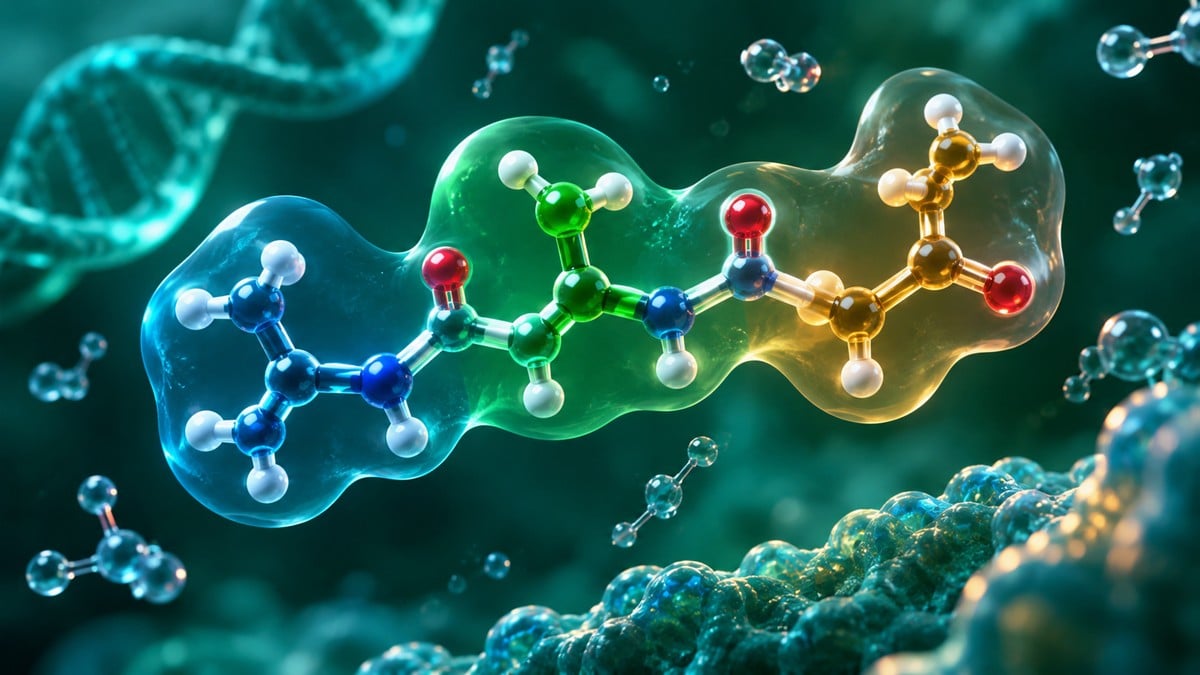
Three amino acids may seem like an unusually small starting point for investigating molecular biology. Compared with proteins containing hundreds or even thousands of amino acid residues, tripeptides possess relatively simple structures. Nevertheless, their chemical diversity offers scientists interesting opportunities to examine fundamental relationships between molecular structure and biological behavior.
Research involving short peptides brings together several scientific disciplines, including organic chemistry, biochemistry, molecular biology and analytical science. These investigations can help researchers understand how individual chemical groups influence molecular interactions and why seemingly minor structural differences sometimes produce distinct experimental observations.
However, the simplicity of a molecule should not be confused with certainty about its biological function. Even a peptide containing only three amino acids can raise complicated questions that require several different types of scientific evidence.
What Makes a Tripeptide Different From a Larger Protein?
A tripeptide consists of three amino acid residues connected through peptide bonds. In a conventional linear tripeptide, two peptide bonds connect the three residues into a continuous molecular structure.
Proteins generally contain much longer amino acid sequences, many of which develop complex three-dimensional arrangements that contribute to their biological functions.
Short peptides possess fewer structural components, but their chemical behavior still depends on multiple characteristics. These include the identity of their amino acids, the arrangement of their chemical groups and their interactions with the surrounding environment.
The relatively small size of a tripeptide can make it useful for investigating specific questions about molecular chemistry. Researchers may be able to examine particular structural characteristics without confronting every complication associated with a much larger protein.
Nevertheless, smaller molecular size does not automatically establish biological activity. It also does not demonstrate that a molecule can enter particular cells, reach specific tissues or interact selectively with a biological target.
Each of those characteristics represents a separate scientific question requiring appropriate experimental evidence.
Why the Order of Three Amino Acids Matters
Amino acids contain chemical groups that influence their individual physical and chemical properties. When several amino acids become connected within a peptide, the resulting molecular characteristics depend partly on how those residues are arranged.
Consider a theoretical tripeptide containing three different amino acids. Rearranging their order can produce molecules that possess the same overall amino acid composition but different sequences.
These molecules may share an elemental composition while displaying different structural arrangements and molecular interactions.
This distinction illustrates why identifying the individual components of a peptide is not necessarily sufficient to establish its complete molecular identity.
Scientists must also determine how those components are connected. Depending on the molecule under investigation, additional structural characteristics may need to be established.
The importance of sequence is particularly apparent when researchers compare related peptides. An observed difference between two compounds may result from changes in the position of an amino acid rather than the introduction of an entirely new chemical component.
By investigating these relationships, scientists can develop a more detailed understanding of how molecular structure influences experimental behavior.
Glutathione Demonstrates the Diversity of Naturally Occurring Tripeptides
Glutathione provides a well-established example of a naturally occurring molecule containing three amino acid components. Its structure includes glutamic acid, cysteine and glycine.
The National Library of Medicine’s PubChem database identifies an unusual structural feature within glutathione. Its glutamic acid component is connected through a side-chain carboxyl group rather than exclusively following the conventional arrangement found in many linear peptides.
Glutathione also contains a sulfur-bearing chemical group associated with cysteine. This group contributes to its participation in cellular oxidation and reduction chemistry.
These structural characteristics illustrate why a peptide’s biological significance cannot be determined solely from the number of amino acids it contains.
Glutathione has established physiological roles, but those roles do not extend automatically to other tripeptides. A different three-residue molecule may possess substantially different chemical characteristics, interact with different biological structures and have an entirely different evidence base.
This example provides a useful foundation for understanding the diversity of short peptides without assigning the properties of one molecule to another.
How Experimental Tripeptides Become Subjects of Molecular Investigation
Not every short peptide investigated by scientists has an established physiological role. Researchers also examine synthetic molecules to explore specific hypotheses about chemical interactions and biological processes.
One example discussed in the scientific literature is the tripeptide Glu-Asp-Arg, commonly abbreviated as EDR and also known as Pinealon.
Its sequence includes glutamic acid, aspartic acid and arginine. These amino acids possess side chains with different chemical characteristics, making the molecule relevant to investigations involving molecular charge and potential interactions with surrounding structures.
Published research has examined hypotheses involving this tripeptide and biological regulation. However, much of the available evidence concerns experimental models rather than established clinical outcomes.
Readers interested in understanding tripeptide research should therefore distinguish the established chemical identity of EDR from proposed biological mechanisms that require further investigation.
A peptide’s sequence can be described with considerable chemical precision while important questions about its behavior within complex biological environments remain unresolved.
Molecular Charge Can Influence Chemical Interactions
Many biological structures contain chemical groups capable of carrying electrical charges. These charges contribute to interactions between molecules and influence their behavior within different environments.
The amino acid components of peptides can include side chains with acidic, basic or electrically neutral characteristics. Their arrangement contributes to the distribution of charge across a molecular structure.
However, the charge associated with a particular chemical group may depend on its surrounding environment. Consequently, the behavior of a peptide cannot always be described completely by considering its amino acids in isolation.
Researchers investigating charged peptides may examine how these molecules interact with other chemical structures under defined experimental conditions.
Such investigations can contribute to scientific understanding of molecular association, but an observed interaction does not automatically establish a particular biological function.
For example, evidence that two molecules associate in a simplified experimental system does not establish that the same interaction occurs within an intact cell or that it produces a measurable physiological outcome.
Distinguishing chemical association from demonstrated biological activity is therefore essential when interpreting research involving short peptides.
Why Molecular Size Does Not Establish Cellular Access
Cell membranes separate intracellular environments from their surroundings. These membranes possess structural and chemical characteristics that influence the movement of substances between biological compartments.
Although molecular size can contribute to transport behavior, it represents only one of several relevant characteristics. Molecular charge, polarity, interactions with membrane proteins and susceptibility to degradation may also influence whether a particular molecule becomes available within a cell.
As a result, the relatively small size of a tripeptide does not establish unrestricted cellular access.
Researchers investigating intracellular interactions must establish whether the molecule actually reaches the biological compartment in which the proposed interaction would occur.
Additional questions concern whether it remains chemically intact, whether its location can be measured reliably and whether alternative explanations account for the observed experimental result.
These requirements become particularly important when scientific discussions involve proposed interactions with intracellular structures such as genetic material or regulatory proteins.
A hypothesis describing what a molecule might do after reaching a particular location is different from evidence demonstrating that it reaches that location and performs the proposed function.
What Different Research Models Can Actually Establish
Scientists employ several types of experimental models to investigate molecular behavior. Each model offers opportunities to answer particular questions while introducing limitations that influence the interpretation of its findings.
Computer simulations can help researchers explore possible molecular arrangements and identify interactions that may deserve experimental investigation. However, a predicted interaction is not equivalent to an experimentally demonstrated one.
Experiments conducted outside living cells can provide information about chemical association and molecular behavior within defined systems. These systems may simplify important variables, allowing researchers to investigate particular relationships more clearly.
Cell-based experiments introduce additional biological complexity. They can provide information about cellular responses and interactions that cannot be investigated through simplified chemical models alone.
Nevertheless, observations made within cultured cells do not necessarily describe behavior within an intact organism.
These different forms of investigation are complementary. Their value lies in answering specific scientific questions rather than independently establishing every characteristic of a compound.
Responsible interpretation requires recognizing which model produced a finding and what additional evidence would be necessary to extend that finding to a more complex biological setting.
Why Chemical Identity and Research Documentation Matter
Before interpreting experimental observations, researchers need confidence that the material under investigation corresponds to its stated chemical identity.
For short peptides, this consideration is particularly relevant when several related compounds possess similar molecular compositions or names.
Analytical documentation can provide information about material characteristics, but its interpretation depends on the questions addressed by the underlying methods.
A measurement related to molecular mass may provide different information from an investigation examining chemical composition or structural arrangement.
Similarly, a reported purity measurement does not independently establish every characteristic of a research material.
Readers examining supplier information through resources such as this research documentation overview should distinguish descriptions of quality processes from independently established evidence concerning individual materials.
Transparent documentation can support scientific accountability by helping readers understand which characteristics were examined and which questions remain unanswered.
However, chemical documentation does not establish clinical safety, medical effectiveness or suitability for human use. Those conclusions require evidence developed for the relevant clinical and regulatory questions.
The Importance of Independent Scientific Investigation
Scientific understanding develops through the accumulation and evaluation of evidence. Individual investigations may identify interesting observations, but broader confidence generally requires examining whether related findings can be established through additional research.
Independent investigations can help determine whether an observation depends on the characteristics of a particular experimental model, analytical method or interpretation.
They can also examine alternative explanations that may not have been addressed in earlier research.
For short peptides with relatively limited published literature, these considerations become especially important. Multiple publications discussing a proposed mechanism do not necessarily represent multiple independent demonstrations of that mechanism.
Readers should distinguish original experimental reports from review articles that summarize earlier findings. They should also consider whether different publications describe genuinely separate investigations or repeatedly discuss the same underlying evidence.
Recognizing these relationships provides a more accurate understanding of the maturity of a research field.
It also helps prevent preliminary observations from acquiring greater apparent certainty simply because similar statements appear across numerous publications.
Small Molecules Can Raise Large Scientific Questions
Tripeptide research illustrates how molecular simplicity and biological complexity can exist together.
Three amino acid residues can create a structure with distinctive chemical characteristics, but understanding how that structure behaves requires attention to molecular arrangement, surrounding conditions and the characteristics of individual experimental models.
Established knowledge about naturally occurring molecules such as glutathione demonstrates the importance of specific structural features. Experimental investigations involving other tripeptides show why scientific conclusions must remain connected to the evidence supporting each individual compound.
The most informative approach to short-peptide research is therefore neither to dismiss small molecules as scientifically uninteresting nor to assume that their size establishes particular biological capabilities.
Instead, researchers can examine these molecules as opportunities to investigate fundamental relationships between chemistry and biology while remaining attentive to the limitations of their observations.
Even when a molecule contains only three amino acids, the scientific questions surrounding its structure, interactions and biological significance can extend across several fields of research.