




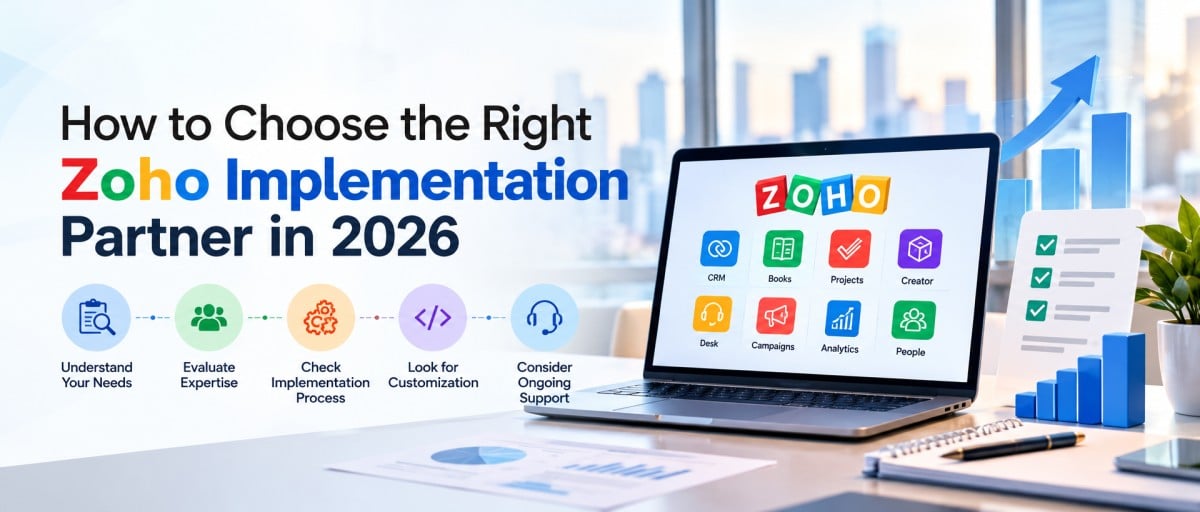
Selecting the appropriate IT partner can have a big impact on how your company handles clients, streamlines processes, and boosts output. Zoho offers a wide range of business applications for sales, marketing, finance, customer support, and project management. However, getting the best results from these tools requires proper planning, configuration, and ongoing support.
This is where a reliable Zoho implementation partner becomes valuable. The right partner can help you select suitable applications, customize workflows, integrate existing systems, and build a solution that supports your business goals.
In this guide, we will explore the key factors to consider when choosing a Zoho partner in 2026.
1. Understand Your Business Requirements
Before selecting a partner, identify the challenges you want to solve. For example, your sales team may need better lead management, your finance department may want to automate invoicing, or your customer support team may need a centralized ticketing system.
Start by listing your business requirements, existing software, manual processes, and expected outcomes.
A professional Zoho consultant should understand your current operations before recommending specific applications. This ensures that your Zoho implementation aligns with your actual business needs instead of introducing unnecessary tools.
2. Check Zoho Partner Experience and Expertise
Not every technology provider has the same level of experience with Zoho products. Look for a partner who understands the applications relevant to your business and has experience implementing them for similar organizations.
Review their portfolio, client testimonials, industry experience, and previous implementation projects. You should also verify any claimed Zoho partner status through official Zoho channels.
An experienced Zoho partner can help you avoid common configuration problems, identify opportunities for automation, and implement solutions that support future growth.
3. Evaluate Their Zoho Implementation Process
A successful Zoho implementation involves more than creating an account and configuring basic settings. It requires a structured approach that considers your business processes, data, integrations, and user requirements.
Request an explanation of the implementation process from possible partners. A reliable process generally includes the following stages:
- Business analysis: Understanding your workflows and objectives.
- Solution planning: Selecting suitable Zoho applications and defining requirements.
- System configuration: Setting up modules, permissions, dashboards, and workflows.
- Data migration: Accurately transferring current client and company records.
- Testing: Checking workflows, integrations, reports, and automation rules.
- Training and launch: Helping employees use the system effectively.
- Ongoing support: Resolving issues and improving system performance.
A clearly defined process helps reduce implementation risks and keeps the project aligned with your business objectives.
4. Look for Zoho Development and Customization Capabilities
Every business has unique operational requirements. Standard software features may not always support every workflow, which makes customization important.
Before hiring a provider, check whether they offer Zoho development services for custom modules, advanced automation, third-party integrations, and specialized business applications.
For example, a company may need to connect Zoho CRM with its website lead forms, integrate accounting software, or create automated notifications for its sales team.
A capable development partner can use appropriate Zoho tools and APIs to extend functionality where necessary. However, customization should solve a specific business problem rather than add complexity without a clear benefit.
5. Compare Zoho Services and Support Options
Implementation is only the beginning of your relationship with a technology provider. You might require more apps, process enhancements, integrations, or staff training as your company expands.
Review the complete range of Zoho services offered by each provider. These may include:
- Zoho CRM implementation and customization
- Zoho Books setup and accounting automation
- Zoho Creator application development
- Zoho Analytics dashboards and reporting
- Zoho applications integration
- Data migration and system configuration
- Employee training and technical support
Ask about support availability, response times, maintenance costs, and how additional requirements will be handled after launch.
6. Understand Zoho Implementation Cost
The cost of Zoho implementation varies depending on the applications selected, business complexity, number of users, customization requirements, integrations, and data migration needs.
Some projects require only basic configuration, while others involve multiple departments and complex workflows.
Request a detailed quotation that separates implementation fees, software subscriptions, customization, training, and ongoing support. This facilitates understanding the total cost of ownership and comparing proposals. A well-planned implementation can help prevent expensive corrections and operational disruptions later.
7. Check Communication and Project Management
Throughout the implementation process, effective communication is crucial. Your partner should explain technical decisions in understandable language, provide regular progress updates, and involve relevant employees during testing.
Ask who will manage your project, how requirements will be documented, and how changes will be approved.
A reliable Zoho implementation partner should establish realistic timelines and explain potential risks before they affect the project. They should also make sure your team understands how the completed solution works.
8. Consider Scalability and Long-Term Business Growth
Your business requirements may change as you acquire more customers, expand into new markets, or introduce additional services.
To enable future growth, choose a partner who can offer a flexible Zoho environment. This includes appropriate user permissions, organized data structures, maintainable integrations, and workflows that can be expanded when necessary.
Your partner should also help you review system performance periodically and identify opportunities to improve automation.
Conclusion
Choosing the right Zoho implementation partner in 2026 requires careful evaluation of experience, technical expertise, implementation methodology, pricing, and ongoing support.
The right provider will understand your business requirements, recommend suitable Zoho applications, and deliver a solution that improves efficiency without creating unnecessary complexity.
If your business is planning to adopt or optimize Zoho applications, VerticalisBS can help you explore Zoho implementation, Zoho development, and other Zoho services tailored to your operational needs.
Ready to improve your business processes with Zoho? Contact VerticalisBS to discuss your requirements and identify an implementation approach that supports your business goals.